

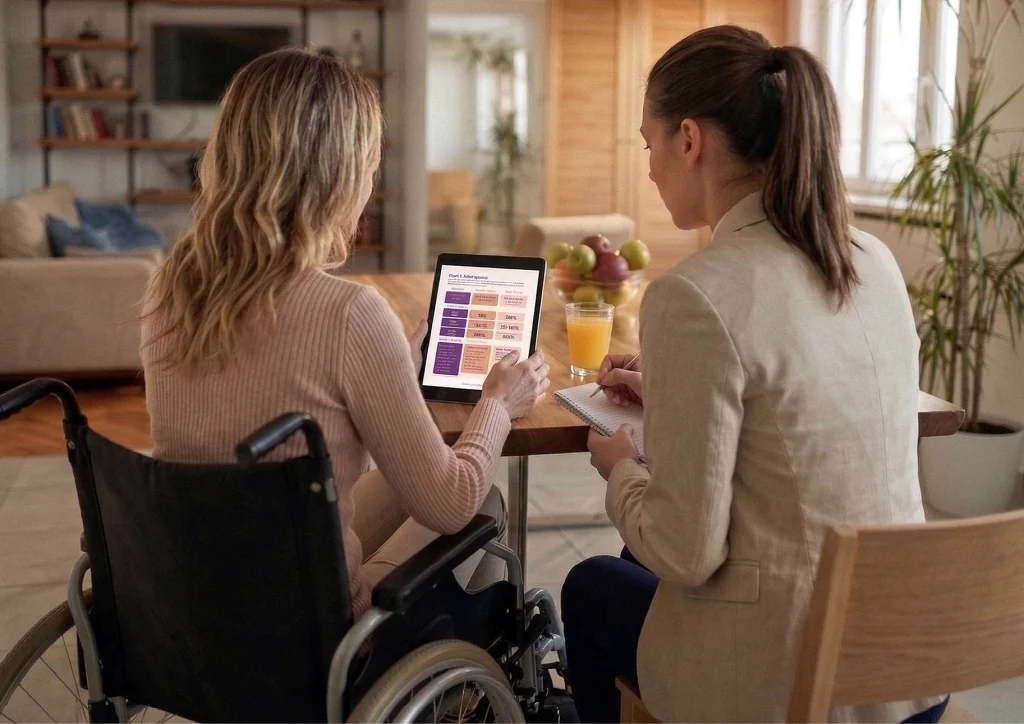
Support at Home Levels 1 to 8 Comparison Table
The Australian aged care landscape has entered a new era. As of 2026, the Aged Care Act 2024 has fully replaced the old “Home Care Packages” (HCP) system with the more flexible, transparent, and rights-based Support at Home program.
For seniors and their families, these changes mean faster access to equipment, clearer pricing, and a system that finally distinguishes between clinical medical needs and everyday household help. This guide breaks down everything you need to know to navigate the 2026 landscape.
Part 1: The 8 Classification Levels
In the old system, you were assigned one of four “Levels.” In 2026, the government uses eight distinct classifications to more accurately match funding to your specific functional needs.
The 2026 Funding Table
The following rates are the national averages for 2026. Note that clinical care is funded separately and does not “eat into” these budgets for personal and domestic tasks.
| Classification | Primary Focus | Approx. Annual Budget | Approx. Quarterly Budget |
| Level 1 | Basic domestic & social support | $11,000 | $2,750 |
| Level 2 | Low-level personal care | $16,500 | $4,125 |
| Level 3 | Moderate hygiene & mobility support | $22,500 | $5,625 |
| Level 4 | High-frequency daily support | $30,500 | $7,625 |
| Level 5 | Intensive daily care & coordination | $41,500 | $10,375 |
| Level 6 | Complex clinical & personal support | $51,000 | $12,750 |
| Level 7 | Very high dependency & team care | $61,500 | $15,375 |
| Level 8 | Highest care & palliative support | $82,000 | $20,500 |
Part 2: The 3 Short-Term Pathways
One of the most significant improvements in 2026 is that you no longer have to wait for a permanent “Level” to get urgent help. The Support at Home program includes three dedicated “Short-Term Pathways.”
1. The Restorative Care Pathway
-
Purpose: To help you regain independence after a setback (like a fall or surgery).
-
Duration: Up to 12–16 weeks.
-
What’s included: Intensive physiotherapy, occupational therapy, and nursing. The goal is to “restore” your function so you may not need long-term care at all.
2. The End-of-Life Pathway
-
Purpose: To provide dignity and comfort for those who wish to spend their final months at home.
-
Priority: This is a high-priority pathway. Assessments are often completed within 48–72 hours.
-
Funding: Access to an additional $25,000 (approx.) over 12 weeks to cover 24/7 nursing and personal support.
3. The AT-HM Scheme (Equipment & Modifications)
-
Purpose: To provide upfront funding for “big ticket” safety items.
-
Funding: Up to $15,000 for items like ramps, walk-in showers, or electric hospital beds.
-
The 2026 Advantage: You no longer have to “save up” your daily care budget for months to buy a wheelchair; the funding is granted upfront based on your assessment.
Part 3: Understanding Your 2026 Costs
In 2026, the way you pay for care has been simplified into three “Service Streams.” A major win for seniors is that Clinical Care is now $0 out-of-pocket.
The Contribution Model
Your contribution is a percentage of the service cost, based on your income and assets test.
-
Clinical Supports (Nursing, Physio, OT): * Cost: $0 for everyone.
-
The government believes medical care should be a right, not a financial burden.
-
-
Independence Services (Personal Care, Respite, Transport):
-
Full Pensioner: 5% contribution.
-
Part Pensioner: 5% – 50% contribution.
-
Self-Funded: 50% contribution.
-
-
Everyday Living (Cleaning, Gardening, Meals):
-
Full Pensioner: 17.5% contribution.
-
Part Pensioner: 17.5% – 80% contribution.
-
Self-Funded: 80% contribution.
-
Part 4: The 10% Care Management Rule
Every Support at Home participant in 2026 is assigned a Care Partner. To fund this, 10% of your quarterly budget is automatically set aside for Care Management.
What your Care Partner does for you:
-
Creates and updates your personalized Care Plan.
-
Coordinates with your GP and specialists.
-
Checks in monthly to ensure you are happy with your workers.
-
Advocates for you if your health declines and you need a higher Level.
Part 5: Rights, Safeguards, and the “No Worse Off” Principle
The Aged Care Act 2024 isn’t just about money; it’s about rights. In 2026, all providers must adhere to a strict Statement of Rights.
-
The Right to Complain: You can lodge a complaint with the Aged Care Quality and Safety Commission without fear of losing your services.
-
The Right to Change: You can switch providers at any time. Your funding is “portable”—it belongs to you, not the agency.
-
The “No Worse Off” Guarantee: If you were already receiving a Home Care Package before November 2025, the government guarantees you will pay the same or less, and receive the same or more care than you did under the old system.
Part 6: Frequently Asked Questions for 2026
How long is the waitlist for a Support at Home package?
In 2026, the “National Priority System” has been streamlined. While Level 1–3 packages are often available within 1–3 months, the higher levels (7–8) are prioritized for those at high risk of nursing home entry. If you are in crisis, the Short-Term Pathways can be activated almost immediately.
What happens to my “Unspent Funds”?
The 2026 rules are stricter regarding unspent money. You can only roll over $1,000 or 10% of your quarterly budget (whichever is greater). This encourages participants to actually use their care hours rather than letting funds sit in an account.
Does the government set the prices?
Yes. From July 1, 2026, strict Price Caps apply to all registered providers. This prevents “price gouging” and ensures that more of your budget goes toward actual care hours rather than administrative overheads.
Can I use my budget to pay for my groceries?
No. While the budget covers the delivery and preparation of meals, it does not cover the raw cost of the food itself, as this is considered a standard living expense everyone pays regardless of age.
Conclusion: Taking the Next Step
Navigating the 2026 aged care system can feel like learning a new language, but the goal is simple: to give you more control and better support at home.
Whether you are just starting with a Level 1 classification or are managing complex health needs at Level 8, the new system is built to be a partnership between you, your family, and your Care Partner.